
Lake Crescent Fish: What Lives Beneath One of Washington’s Deepest Lakes
Lake Crescent is one of the most iconic bodies of water on the Olympic Peninsula—deep, glass-clear, glacier-carved, and home to fish species that don’t exist anywhere else on Earth. Yes, literally nowhere else. If you fish the Olympic Peninsula and haven’t explored Lake Crescent yet, you’re missing a rare opportunity to encounter uniquely evolved trout in a pristine, protected ecosystem.
This guide breaks down what swims below the cobalt surface, how these fish came to be, and what anglers should know before planning a trip.
How Lake Crescent Created Its Own Fish Species
Roughly 8,000 years ago, a massive landslide at Indian Creek cut Lake Crescent off from Lake Sutherland and the Lyre River drainage. That geological event sealed off the lake entirely, leaving trout populations isolated with no ability to mix, migrate, or spawn elsewhere.
Isolation + time + deep, nutrient-poor water = accelerated evolution.
As a result, two species emerged independently from the original coastal rainbow and cutthroat stock:
Beardslee Trout — A unique strain of rainbow trout found only in Lake Crescent
Crescenti Cutthroat Trout — A genetically distinct cutthroat trout species also found only in this lake
They are protected, rare, and federally recognized for conservation significance.
1. Beardslee Trout (Oncorhynchus mykiss irideus)

If Lake Crescent had a mascot, it would be the Beardslee Trout.
What Makes Them Unique
Endemic to Lake Crescent (no other lake has them)
Colors are muted due to the low-productivity, clear water environment
Typical Size
Common: 2–6 lbs
Exceptional: 8–12+ lbs
Conservation Status
Beardslee numbers declined sharply in the early 2000s due to habitat degradation in the Lyre spawning channel. Today, strict regulations exist to protect them:
No retention
Barbless hooks only
No bait
If you hook one, fight and land quickly, keep it in the water, and release immediately.
2. Crescenti Cutthroat Trout (Oncorhynchus clarkii)
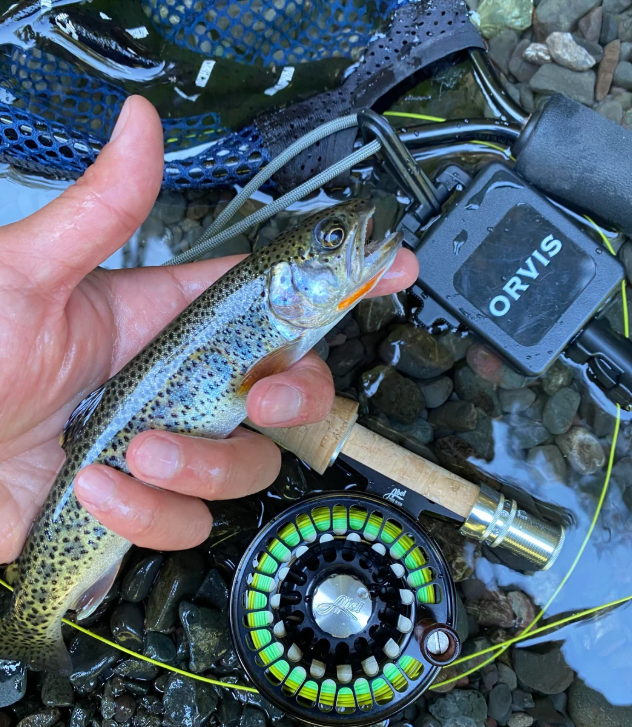
While Beardslee get the attention, Crescenti cutthroat are just as special.
What Sets Them Apart
Unique genetic strain, not identical to coastal cutthroat elsewhere
Highly adapted to the lake’s nutrient food web
Often found shallower than Beardslee
Typical Size
12–18 inches on average
Occasionally over 20 inches
Color, Depth & Clarity: Why Crescent Fish Look Different
Lake Crescent is:
Ultra-deep: over 600 feet
Glacial blue
Oligotrophic (nutrient poor)
Exceptionally clear (visibility often > 60 feet)
Low phytoplankton levels = low forage density
Low forage density = slower but longer predatory growth cycles
This is why:
Fish are pale
Energy efficiency matters
Large apex trout remain few but impressive
You don't get explosion-level insect hatches or summer weed beds here. The fish have adapted to minimal calories and maximal stealth.
Fishing Regulations You Need to Know
Because these fish are rare, the rules are strict and should be followed without debate.
Key Regulations
Catch and release only
Barbless artificial lures only
No bait
No more than 2 ounces of weight, no down riggers.
You’re in a national park. They don’t play around with enforcement.
When to Fish Lake Crescent
Summer
April–June: cutthroat feeding surge
September–October: temperature drop, trout move shallow
Watercraft Advantage
Kayak or float tube anglers fare better here than shoreline casters. The drop-offs are sheer.
Fly Patterns That Actually Work
Lake Crescent isn’t your typical “match the hatch” lake. The prey base is bigger, meatier, and more pelagic.
For Crescenti Cutthroat
Chironomid emergers
Black leech patterns
Small olive buggers
McLeod’s chironomid pupa
For Beardslee
Deep-running baitfish patterns
Grey/white sculpin streamers
Kokanee imitations (barbless only)
You’re not stripping woolly buggers across a weed bed here. You’re probing abyssal blue water.
Why Lake Crescent Fish Matter to the Olympic Peninsula
Two words: genetic heritage.
This lake isn’t just pretty. It’s a living lab of isolated evolution. The Olympic Peninsula has plenty of salmon, steelhead, and coastal trout—but nowhere else holds genetically distinct lake-locked trout that split off millennia ago and survived in total isolation.
Losing Beardslee or Crescenti would mean losing an entire evolutionary branch of trout forever. Every regulation and every release matters.
Final Thoughts
Lake Crescent fish aren’t just another trout population; they’re biological artifacts from a sealed-off, post-glacial world. The Beardslee and Crescenti exist because a landslide locked them into a radically clear, nutrient-stripped, cold-water basin and forced evolution to take over. As anglers, the privilege of pursuing them comes with responsibility: barbless hooks, careful handling, no shortcuts, no ego shots on the rocks.
If you want stunning scenery, deep-water trout with prehistoric lineage, and a brush with one of the rarest freshwater fish populations in North America, Lake Crescent delivers—but you’d better show up with respect.